Monday, August 10, 2026

The Last Double Eagle: Chapter One


Chapter One

The Coin That Should Not Exist

The first thing Elias Venn noticed about the coin was the absence of wear.

The second was the date.

He had seen thousands of Double Eagles in his career. He had held them beneath magnification, weighed them on balances sensitive enough to detect a fingerprint, examined their surfaces under ultraviolet light and angled illumination. He had learned to distinguish an authentic coin from a counterfeit by details so minute that most people would have considered them meaningless.

A die crack in the wrong place.

A microscopic raised line beneath Liberty's torch.

The particular way a serif ended on the numeral 3.

A coin told the truth if you knew how to ask it questions.

The gold piece lying inside the velvet-lined tray on his desk was telling him something he didn't want to hear.

Venn leaned closer.

"Impossible," he said.

He immediately disliked the word.

Impossible was the word amateurs used when they encountered something they didn't understand. Professionals used unlikely. They used inconsistent. They used unverified.

They never used impossible.

Not unless they were very sure.

He reached for his loupe.

The coin was a 1933 Saint-Gaudens Double Eagle, twenty dollars in gold, with Liberty striding confidently toward the viewer, torch raised in her right hand and olive branch in her left. Behind her, the sun was rising.

The date was unmistakable.

1933.

Venn turned the coin over.

The reverse showed the familiar eagle in flight, wings spread against a field of sunlight.

UNITED STATES OF AMERICA.

TWENTY DOLLARS.

IN GOD WE TRUST.

Everything was correct.

Everything except the condition.

The coin looked as though it had been struck yesterday.

Venn set down the loupe.

"Where did you say this came from?"

Across the desk, Margaret Bell folded her hands.

"The estate."

"I understand that. Which part of the estate?"

She hesitated.

"The collection."

"Whose collection?"

"Thomas Weller."

Venn looked at her.

"The Thomas Weller?"

She nodded.

That complicated matters.

Thomas Weller had been one of the great private collectors of American coins. He had assembled a collection over nearly sixty years, spending enormous sums on pieces most people would have difficulty distinguishing from pocket change. He had owned Colonial rarities, early federal coinage, patterns, territorial issues, Confederate pieces, and a remarkable group of gold coins.

But Weller had never owned a 1933 Double Eagle.

At least, not publicly.

Venn looked again at the coin.

"Who authenticated it?"

"No one."

"Who appraised it?"

"No one."

"Who knew you had it?"

Mrs. Bell looked uncomfortable.

"I told you."

"Yes."

"You are the first person I've shown it to."

Venn picked up the coin with cotton gloves.

"Why me?"

"Because Mr. Weller left instructions."

"What kind?"

"He wrote your name."

That caught Venn's attention.

"On the coin?"

"No."

She reached into her handbag and removed a folded sheet of paper.

The paper had yellowed edges. It looked old, but not sixty years old. More like something that had been stored badly for a few decades.

She handed it across the desk.

Venn unfolded it.

There were only two sentences.

If a 1933 Double Eagle is ever found among my possessions, take it to Dr. Elias Venn.

Do not allow the government to take it.

Venn read the sentences twice.

Then a third time.

"Did Weller write this?"

"I believe so."

"You believe?"

"He died eleven days ago. I'm still sorting through the estate."

"When was this written?"

"I don't know."

Venn held the paper beneath his desk lamp.

There was no date.

No signature.

Just the two sentences.

"Did Weller ever mention the coin to you?"

"No."

"Did he mention me?"

"No."

"Then why did he leave instructions?"

"I was hoping you could tell me."

Venn smiled faintly.

"I was hoping you could."

Neither of them spoke.

Rain tapped against the windows of the small office.

Outside, the afternoon had turned gray. The building where Venn maintained his laboratory and private collection had once been a bank, and the architecture still reflected its former purpose: thick stone walls, tall windows, heavy doors.

It was appropriate.

Coins belonged in places built to protect secrets.

Venn placed the coin beneath the microscope.

The image appeared on the monitor.

At first he saw nothing unusual.

The familiar engraving filled the screen.

Liberty's face.

The folds of her gown.

The rays of the rising sun.

He adjusted the focus.

Then the magnification.

Then again.

He moved across the surface toward the date.

There.

He stopped.

"What's wrong?" Mrs. Bell asked.

"Nothing."

But his voice had changed.

Venn increased the magnification.

A tiny mark appeared beside the final digit.

It was almost invisible.

At normal scale it looked like a scratch.

Under magnification, it was something else.

A pattern.

Three short lines.

A space.

Two lines.

Another space.

Then a cluster of tiny circles.

Venn stared at it.

"That's not part of the die."

"What does it mean?"

"I don't know."

He adjusted the illumination.

The pattern disappeared.

He changed the angle.

It returned.

He changed the wavelength of the light.

It disappeared again.

Venn felt the first cold sensation of unease.

He had spent his life around counterfeiters, altered coins, struck-over dates and fabricated rarities. A determined forger could do extraordinary things.

But this was not engraving.

The marks were beneath the surface.

"Mrs. Bell."

"Yes?"

"Where was this coin kept?"

"In a safe."

"Whose safe?"

"Weller's."

"Was it sealed?"

"I don't understand."

"Was the safe ever opened after his death?"

"No."

"Are you certain?"

She looked offended.

"Yes."

Venn removed the coin from beneath the microscope.

"Did you see anyone enter Weller's house after he died?"

"No."

"Did anyone have access to the collection?"

"The lawyers. The executor. The family."

"Anyone else?"

"I don't know."

Venn looked down at the coin.

He had the sudden, irrational impression that it was looking back at him.

He dismissed the thought.

Coins did not look at people.

People looked at coins.

That distinction mattered.

He placed the Double Eagle on the electronic balance.

The machine registered:

33.436 g

Venn frowned.

The standard weight of a Double Eagle was 33.436 grams.

Exactly.

He weighed it again.

The same result.

He checked the diameter.

34 millimeters.

Thickness.

Correct.

He measured the specific gravity.

Correct.

Every physical measurement was consistent with an authentic United States Mint Double Eagle.

And yet the coin was almost certainly not supposed to exist.

In 1933, the Philadelphia Mint had struck hundreds of thousands of Double Eagles.

But President Franklin Roosevelt's abandonment of the domestic gold standard had changed everything.

The coins were never released into general circulation.

Most were melted.

Only a handful were known to have survived.

And every surviving specimen had a documented history.

Every one.

Venn knew that history better than almost anyone alive.

He knew the stories of the coins that had escaped the melting pots.

He knew about the pieces that had disappeared.

He knew about the examples that had surfaced decades later under circumstances ranging from questionable to absurd.

And he knew the government had never regarded the 1933 Double Eagle as an ordinary collectible.

That was why Weller's warning bothered him.

Do not allow the government to take it.

Why would Thomas Weller have anticipated that?

Venn looked toward Mrs. Bell.

"Does anyone know you brought this here?"

She shook her head.

"Not the family?"

"No."

"The executor?"

"No."

"The government?"

"Absolutely not."

Venn nodded.

"Good."

Mrs. Bell stood.

"Can you authenticate it?"

"I can tell you whether it is consistent with an authentic 1933 Double Eagle."

"Isn't that the same thing?"

"No."

She waited.

Venn looked at the coin.

"I've never seen anything like this."

"Is that good?"

"No."

She gave him a nervous smile.

"How much is it worth?"

Venn almost laughed.

"If it's genuine?"

"Yes."

He looked at her.

"The value isn't the problem."

"What is?"

Venn slid the coin beneath the microscope again.

"Where it came from."


Mrs. Bell left at 4:37.

Venn watched her walk across the parking lot from the second-floor window.

She stopped once.

Turned.

Looked back at the building.

Then continued toward her car.

Venn waited until she drove away.

Only then did he lock the laboratory door.

He returned to his desk.

The coin was still there.

He stared at it.

For nearly thirty years, Venn had collected historical objects because they provided one thing that modern life rarely offered:

certainty.

A coin had been struck at a particular place, at a particular time, for a particular purpose.

The metal had entered the world.

People had spent it.

Lost it.

Buried it.

Collected it.

Passed it from hand to hand.

History left fingerprints on everything.

That was what made numismatics fascinating.

A coin was a piece of history small enough to hold between two fingers.

Venn picked up the Double Eagle.

It felt warm.

He stopped.

He set it down.

Then he touched it again.

Warm.

Not room temperature.

Warm.

He checked the thermometer.

Twenty-one degrees Celsius.

He touched the coin.

It was noticeably warmer than the metal tray beneath it.

Venn frowned.

He picked up the infrared thermometer.

The tray registered 21.4 degrees.

The coin registered—

37.1.

He stared at the display.

He took the reading again.

37.0.

He checked the thermometer against a known object.

Accurate.

He put the coin down.

Waited thirty seconds.

Measured it again.

36.9.

Venn reached for the telephone.

He stopped.

Who would he call?

A physicist?

A metallurgist?

The police?

The Smithsonian?

The Mint?

The last possibility made him remember the note.

Do not allow the government to take it.

He looked at the coin.

Then at the locked laboratory door.

Something had changed.

He was certain of it.

Not the coin.

The room.

The air seemed suddenly still.

The lights flickered.

Once.

Twice.

The computer monitor went black.

Venn stood.

The laboratory fell silent.

Then the monitor came back on.

A file had appeared on the desktop.

Venn stared at it.

The filename was:

1933

He had not created it.

He walked toward the computer.

The file date read:

August 15, 1933.

Venn's hand hovered over the mouse.

He clicked.

A single image appeared.

It showed the Philadelphia Mint.

The photograph was black and white.

The image quality was poor.

But Venn recognized the building.

He recognized the street.

And he recognized the date.

He enlarged the photograph.

At first there was nothing unusual.

Then he saw the man standing on the steps.

Venn leaned closer.

The man was wearing a dark suit.

His face was partially obscured by shadow.

But there was something about him.

Something familiar.

Venn enlarged the image again.

The photograph became grainy.

The man's face came into focus.

Venn stopped breathing.

He was looking at himself.

Not exactly.

The man was older.

Much older.

His hair was gray.

His face was thinner.

But there was no mistaking the resemblance.

Venn stepped backward.

The computer screen went black.

A second later, a line of white text appeared.

YOU HAVE FOUND THE LAST ONE.

Another line appeared beneath it.

DO NOT LET THEM TAKE IT BACK.

Then a third.

THEY ARE ALREADY COMING.

Venn stared at the screen.

For several seconds, nothing happened.

Then, somewhere downstairs, the building's front door opened.

Venn heard footsteps.

Slow.

Measured.

Coming up the stairs.

He looked at the Double Eagle.

For the first time in his life, Elias Venn wondered whether a coin could be dangerous.

The footsteps stopped outside his laboratory.

Someone knocked.

Three times.

Venn did not move.

The knocking came again.

Three times.

Then a man's voice spoke through the door.

"Dr. Venn?"

Venn stared at the coin.

The voice continued.

"We need to talk about the Double Eagle."

Venn reached for the light switch.

The laboratory went dark.


Tuesday, July 28, 2026

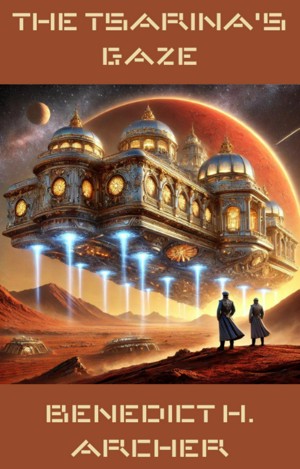
The Tsarina's Gaze

 In the shadow of the Winter Palace, a daring mission is set to redefine humanity's place in the cosmos. Captain Dmitry Karamzin leads the crew of The Tsarina's Gaze on an unprecedented voyage to Mars, seeking to uncover the secrets of a long-lost Martian civilization.


But not all aboard the ship share the mission's noble intent. Count Pavel Zavoysky, driven by ambition and the allure of unbounded power, betrays his comrades in a desperate bid to seize control of the Martian technology. As the crew battles collapsing structures, raging dust storms, and internal discord, they must unite to preserve the fragile harmony between human ingenuity and Martian wisdom. Amidst the chaos, Dr. Natalya Orlova deciphers the intricate secrets of the Martian conduits, proposing a daring plan to stabilize the crumbling city and repair their ship. With time running out and their future hanging in the balance, Captain Karamzin must confront his own doubts and lead his crew through the darkest moments of their journey. As The Tsarina's Gaze races back to Earth, the crew faces their greatest challenge yet: a dramatic re-entry into Earth's atmosphere and an uncertain reception from the imperial court. Will Empress Catherine celebrate their monumental discoveries, or condemn them for their perceived failures? With the caretaker's final gift shimmering with promise, the fate of both civilizations rests on the crew's ability to balance ambition with wisdom. "The Tsarina's Gaze" is a thrilling science fiction adventure that explores the boundless potential of knowledge and the enduring spirit of exploration. Amidst interplanetary conflict and personal betrayals, it delves into the profound truths that true power lies not just in discovery, but in the humility and unity with which it is wielded. Embark on a journey where history and future collide, and witness the triumph of humanity's curiosity as it transcends planets and forges a path toward a harmonious tomorrow.

Thursday, July 16, 2026

Volonaut Airbike

Meet the Volonaut Airbike: a flying superbike engineered to redefine personal mobility.


Born from a passion for flight and ultimate freedom, the Volonaut Airbike materializes the speeder bike of your dreams.

By replacing exposed propellers with ultra-compact, redundant jet propulsion, this sleek carbon-fiber machine brings the concept of a real-world hoverbike to life. Weighing seven times less than a traditional motorcycle, its minimalist design lets the rider truly become one with the sky.

Experience the purest, most thrilling rush of flight. Glide through the air at speeds up to 124 mph, completely protected by a safe, hands-free flight-computer stabilization system.

The Volonaut Airbike is the result of years of "stealth" mode development and relentless determination by Polish inventor and entrepreneur Tomasz Patan.


Friday, July 10, 2026

Dune: Part Three - Paul Atreides Faces A Once Beloved Ally

 We had heard that a new trailer for Dune: Part Three would be released on Wednesday, but it turned out to be a new poster for the third and final chapter in Denis Villeneuve's sci-fi trilogy.

The one-sheet finds Paul Atreides (Timothee Chalamet) facing off against Chani (Zendaya).

The ending of Part Two indicated that Chani had lost faith in her leader/lover, and it looks like they will indeed become full-blown enemies in this movie.

This marks a significant deviation from Frank Herbert's novels, but it is an understandable change, since Chani doesn't really play much of a part in the story after the second book.

“The years don’t seem to have been kind to anyone on Dune," Zendaya said during CinemaCon earlier this year.

"It’s been an ungentle and unkind few years. There’s so much left to fight for.” She continued about Chani, “That youthful outlook is completely gone.”

As for Paul, Chalamet said that his character has now "become his worst vision,” adding that the once noble hero is "an all-powerful emperor of the dark universe” in the threequel.


Wednesday, July 1, 2026

Sci-Fi Stories and Movies That Echo the Spirit of the American Revolution

The American Revolution was a defining moment of rebellion, independence, and the fight against tyranny. Interestingly, many science fiction stories and movies explore similar themes—challenging authority, fighting for freedom, and sparking revolutionary change. Here are some notable sci-fi works that echo the spirit of the American Revolution.


### 1. *Star Wars: A Rebel Alliance’s Fight for Freedom*


The *Star Wars* saga, especially the original trilogy, vividly parallels revolutionary themes. The Rebel Alliance's fight against the oppressive Galactic Empire mirrors the American colonies’ struggle against British rule. The rebels seek liberty and justice, confronting a powerful, authoritarian regime with courage and resilience—embodying the revolutionary spirit. The iconic line, "The Force will be with you, always," symbolizes hope and resistance.


### 2. *V for Vendetta*


While not set in space, *V for Vendetta* is a powerful story about uprising against a totalitarian government. V’s fight to overthrow a corrupt regime echoes the colonial quest for independence. The masks, symbolism, and themes of revolution and individual freedom make it a modern allegory for revolutionary movements, reminiscent of the ideals that fueled the American Revolution.


### 3. *The Matrix*


The *Matrix* trilogy explores themes of control, rebellion, and awakening. Neo’s journey from a disillusioned individual to a revolutionary leader fighting against an oppressive AI system parallels the fight for liberation from tyranny. The film questions reality and authority, inspiring viewers to challenge oppressive systems—much like the colonies challenged British dominance.


### 4. *Battlestar Galactica*


This reimagined series features humans fighting to reclaim their independence from the robotic Cylons. The theme of rebellion against an oppressive oppressor reflects the struggle for sovereignty and self-determination. The series also delves into questions of morality, identity, and what it means to be free.


### 5. *Independence Day*


Though more of a battle against alien invaders, *Independence Day* taps into the classic themes of fighting off an external oppressor to preserve humanity’s freedom. It’s a modern homage to the idea that unity and resilience can overcome even the most formidable enemies.


---


### Final Thoughts


Science fiction often mirrors the core values of the American Revolution—defiance against tyranny, the pursuit of liberty, and the courage to stand up for what’s right. These stories inspire us to reflect on our own fight for freedom, whether on Earth or beyond the stars.


Monday, June 15, 2026

It Conquered the World

 "It Conquered the World" is a 1956 American science fiction film directed by Roger Corman, featuring themes of alien invasion and Cold War anxieties.

Film Details

  • Director: Roger Corman
  • Release Year: 1956
  • Cast: Peter Graves, Lee Van Cleef, Beverly Garland, Sally Fraser
  • Production: The film was produced independently and shot in black-and-white. It was released by American International Pictures as a double feature alongside "The She-Creature" .

Plot Summary

The story revolves around an alien creature from Venus that seeks to conquer Earth. The creature communicates with a disillusioned scientist, Dr. Tom Anderson (played by Lee Van Cleef), who believes that the alien's intervention will bring peace to humanity. However, the alien's true intention is to enslave humanity using mind control devices, claiming that it desires to eliminate emotions to create a peaceful world. As the alien disrupts power on Earth, chaos ensues, leading to tragic consequences for those who trust the creature.

Themes and Cultural Context

"It Conquered the World" reflects the anxieties of the Cold War era, particularly fears of communism and the loss of individuality. The film uses the alien invasion narrative as a metaphor for the perceived threat of brainwashing and emotional suppression. Critics have noted that the film cleverly critiques the idea of seeking external solutions to human problems, emphasizing that true change must come from within.

Reception

While not considered a classic in the same vein as other 1950s sci-fi films, "It Conquered the World" has gained a cult following for its campy style and low-budget charm. It is often appreciated for its entertainment value rather than its cinematic quality, typical of Roger Corman's productions.
This film remains a notable example of the genre, encapsulating the fears and cultural narratives of its time while providing a unique blend of science fiction and social commentary.


Friday, June 5, 2026

Mega Man: The Blue Bomber Who Defined a Generation

For nearly four decades, few video game heroes have remained as recognizable and beloved as Mega Man. Known as Rockman in Japan, the iconic blue robot has battled evil scientists, conquered impossible platforming challenges, and inspired generations of gamers since his debut in 1987. While many gaming franchises have risen and fallen over the years, Mega Man continues to stand as one of the industry's most enduring legends.

The Birth of a Gaming Icon

Created by Capcom during the golden age of the Nintendo Entertainment System, Mega Man arrived at a time when platform games dominated the gaming landscape. Unlike many action heroes of the era, Mega Man wasn't a warrior built for combat. Originally designed as a household robot named Rock, he volunteered to be transformed into a fighting robot to stop the evil Dr. Wily and his army of Robot Masters.

This simple yet compelling premise helped distinguish Mega Man from other heroes. Rather than relying solely on jumping and shooting, players could defeat enemy bosses and acquire their unique weapons. This innovative mechanic introduced a level of strategy rarely seen in action games at the time.

The Formula That Changed Everything

One of Mega Man's greatest innovations was allowing players to choose the order in which they tackled stages. Instead of following a linear path, gamers could challenge Robot Masters in whatever sequence they preferred.

The catch? Every boss had a weakness to another boss's weapon.

Discovering these weaknesses became a puzzle in itself. Defeat Cut Man to gain the Rolling Cutter. Use that weapon against Elec Man. Take Elec Man's Thunder Beam to exploit another boss's vulnerability. This rock-paper-scissors approach transformed every game into a strategic adventure.

The formula became so successful that it influenced countless action games that followed.

The Golden Era

Many fans consider the NES entries—particularly Mega Man 2, Mega Man 3, and Mega Man 4—to represent the franchise's golden age. These titles refined the gameplay, introduced memorable Robot Masters, and delivered some of the most iconic music in gaming history.

Who could forget stages like Metal Man's industrial fortress or the intense showdown with Shadow Man? The catchy soundtracks remain celebrated decades later, frequently appearing in remixes, orchestral performances, and fan tributes.

Mega Man's challenge also became legendary. These games demanded precision, patience, and perseverance. Victory felt earned, making every defeated boss and completed stage immensely satisfying.

Expanding the Universe

As technology advanced, so did Mega Man.

The franchise expanded into numerous sub-series, each offering its own unique spin on the formula:

  • Mega Man X introduced faster gameplay, wall-jumping, and a darker storyline.

  • Mega Man Legends ventured into 3D action-adventure gameplay.

  • Mega Man Battle Network blended role-playing mechanics with card-based combat.

  • Mega Man Zero delivered a more mature narrative and intense difficulty.

  • Mega Man ZX continued the futuristic timeline with exploration-focused gameplay.

Each series attracted new fans while preserving the core spirit of innovation and challenge.

Why Mega Man Endures

The secret to Mega Man's longevity lies in its simplicity. The controls are easy to understand, but mastering the games requires skill and determination. Every obstacle feels fair, and every victory feels rewarding.

The franchise also embraces creativity. Robot Masters can be based on almost anything—from construction equipment and animals to elemental forces and futuristic technology. This endless variety keeps each adventure fresh and memorable.

Most importantly, Mega Man represents optimism. Despite overwhelming odds, the Blue Bomber never gives up. His courage, resourcefulness, and determination resonate with players of all ages.

Looking Toward the Future

While the franchise has experienced periods of dormancy, interest in Mega Man remains remarkably strong. New collections, re-releases, and modern entries have introduced the Blue Bomber to a new generation of players.

The gaming industry has changed dramatically since 1987, but Mega Man's appeal remains timeless. Whether you're revisiting the classic NES adventures or discovering the series for the first time, the franchise offers a reminder of what makes video games special: challenge, creativity, and the joy of overcoming seemingly impossible obstacles.

As long as gamers continue to seek memorable adventures and rewarding gameplay, Mega Man's legacy will endure. The Blue Bomber may be made of circuits and steel, but his place in gaming history is firmly set in stone.


The Last Double Eagle: Chapter Five

  Chapter Five The Last Double Eagle The machine began with a sound like thunder heard from very far away. Elias Venn stood beneath it, unab...